Buying Guide
Stand Mixers Buying Guide
Everything you need to know before buying a stand mixer in the UK — capacity, wattage, tilt-head vs bowl-lift, attachments and bowl material, with real models and prices.
What is a stand mixer
A stand mixer is a countertop appliance with a fixed motor and a rotating mixing action. You attach a beater, dough hook or whisk to a vertical spindle and the machine does the work while the bowl stays still. In the UK the most common capacities are 3.5L to 5L for everyday use, with 6L to 8L models aimed at batch bakers and bread makers.
UK context
How stand mixers work
Stand mixers use a planetary mixing action: the attachment rotates on its own axis while the spindle orbits the bowl, touching every part of the mixture. This is why you can leave the machine running while scraping is rarely needed. Higher wattage helps when mixing stiff dough, but frame stiffness and gear design matter more than peak watts for bread-making.
What a stand mixer cannot do
Stand mixer vs hand mixer
A hand mixer is cheap, light and easy to store. It is fine for light cakes and occasional whisking, but it struggles with stiff dough and large batches. A stand mixer is hands-free, keeps the bowl stationary and handles thick mixtures without tiring your arm. If you bake bread, make pasta or do weekly batch bakes, a stand mixer pays for itself in time.
Tilt-head vs bowl-lift
Tilt-head mixers hinge the head back so you can drop the bowl in or scrape down the side without reaching under the motor. They suit most home kitchens. Bowl-lift mixers keep the head fixed and raise or lower the bowl mechanically. They are more stable when mixing heavy dough, but they take more depth and are harder to add ingredients mid-mix.
Bowl capacity: how big do you need
Bowl sizes run from 3.5L to 8L in our reviewed range. A 3.5L to 4.5L bowl suits singles and couples; 5L covers most family baking; 6L+ is better if you bake bread, pizzas or large cakes regularly. Bigger is not always better: a 6L bowl on a 300W motor can struggle just as much as a 4.5L bowl on a stronger unit.
- 3.5-4.5L: couples, small kitchens, light mixing
- 5L: standard family baking and most doughs
- 6L-8L: batch bakers, bread dough, large cakes
Wattage and power
Wattage indicates motor size, not mixing speed. Most home stand mixers sit between 300W and 1500W. For bread dough, frame stiffness and gear design matter more than a higher peak wattage printed on the box. A 500W well-built mixer can outperform a poorly built 1000W model on thick dough.
Speed settings and controls
Look for a minimum slow-start setting and a clear speed progression. A sudden burst at switch-on can throw flour or egg mixture out of the bowl. Models with pulse or a dedicated dough setting are easier to use for bread.
Attachments and accessories
Most UK stand mixers include a beater, dough hook and whisk in the box. Premium models add a flexi-beater, splash guard, pouring shield or food processor attachment. Multi-function units such as the Bosch 7-in-1 add blender, juicer and shredder attachments. Check whether extra accessories are included or sold separately before comparing prices.
Bowl material and lid
Stainless steel bowls are standard, dishwasher-safe and durable. Glass bowls are heavier and let you see the mix, but they chip if dropped. Plastic bowls are light and cheap, but they scratch and stain over time. A tight-fitting lid or splash guard reduces airborne flour, which matters for hygiene and clean-up.
Kitchen footprint and storage
Measure your counter depth before buying. A tilt-head mixer is usually shallower than a bowl-lift unit. Some stand mixers are tall enough to sit under wall cupboards only with the head down; others will not fit at all. If you store yours in a cupboard, weight also matters — a 5L all-metal mixer is a two-handed lift.
Noise and comfort
Stand mixers are not silent on dough mode, especially on higher speeds. A well-damped motor sounds harsher on stiff dough; plastic-gear units can whine under load. If noise matters and you have an open-plan kitchen, look for DC-motor models or plan to mix dough at lower speeds with longer run times.
Budget vs mid-range vs premium
Budget models under £120 are fine for light mixing, cakes and occasional use. Mid-range models from £120 to £260 add better build, larger bowls and more attachments. Premium models above £260, notably KitchenAid and Kenwood Titanium, last longer, hold resale value better and usually include better service networks.
Who should buy what
| Buyer type | Recommended setup | Why |
|---|---|---|
| Casual baker | 4-5L tilt-head, 300-500W | Light mixing, cakes, easy storage |
| Weekly baker | 5L tilt-head or bowl-lift, 500-800W | Family batches, bread-capable |
| Batch baker / bread | 6L+ bowl-lift, 800W+ | Stability and capacity for heavy dough |
| Small kitchen | 3.5-4.5L tilt-head, compact footprint | Fits tight counters and cupboards |
| All-in-one cook | Multi-function unit with blender/juicer | One appliance, fewer gadgets |
Common buying mistakes
- Buying by wattage alone: stiffness and design matter more for dough.
- Ignoring headroom: if the head hits the wall, capacity is wasted.
- Paying for attachments you will never use.
- Forgetting bowl weight: a filled stainless steel bowl is heavy, especially when lifted over your head.
- Assuming portable means lightweight: some 5L tilt-head models are best left on the counter.
Final buying advice
Start with bowl size for your household: 4.5L to 5L covers most UK families, 6L+ if you make bread regularly. Choose tilt-head for flexibility and small kitchens; choose bowl-lift if heavy dough dominates your baking. Buy from a brand with local UK support and spare-part availability if you plan to keep the mixer for years.
Related Reviews

Vospeed
Vospeed Stand Mixer 8L Cake Mixer Electric Kitchen Food Mixer with Stainless Steel Bowl, Beater, Dough Hook, Whisk for Baking, Dishwasher Safe (Black)

Salter
Salter Marino Baking Stand Mixer - 6 Speed Kitchen Mixer With Pulse, 5L Stainless Steel Mixing Bowl, Removable Splash Guard, Whisk, Dough and Beater Attachment, 1200W, Blue/Grey

Bosch
Bosch 7 in 1 Stand Mixer MUMS2VM40G 7 Speeds, dough hook, whisk, beater, blender, juicer, shredder, 900W, Black
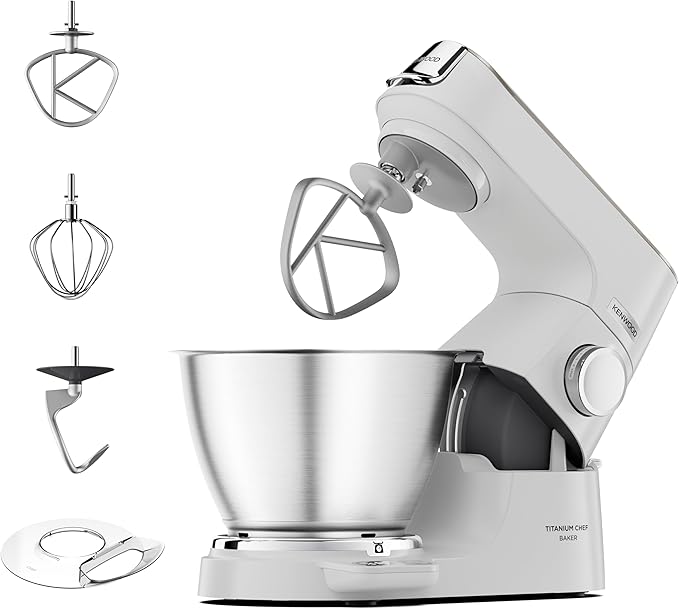
Kenwood
Kenwood Titanium Chef Baker, Kitchen Machine with K-Whisk, Stand Mixer with Kneading Hook, Whisk and 5L Bowl, KVC65.001WH, Power 1400W, White

KitchenAid
KitchenAid Artisan Stand Mixer (Contour Silver, Stainless Steel, 50/60Hz) 5KSM125BCU

Vospeed
Vospeed Stand Mixer, 4.5L+5L Bowls 8-speed 1000W Tilt-Head Food Mixer, Kitchen Electric Mixer with Dough Hook, Whisk, Beater, Splash Guard (Black)

VIVOHOME
VIVOHOME 1500W Stand Mixer for Baking 5.7L Tilt-Head Kitchen 10 Speed | Electric Food Mixer Make Bread with Beater, Dough Hook and Egg Separator
Recommended Reading
Best Products
Best Stand Mixers
Comparison
KitchenAid vs Kenwood vs Bosch Stand Mixer
Comparison
Small vs Large Capacity Stand Mixer
Comparison
Budget vs Premium Stand Mixer
Review
Vospeed Stand Mixer 8L Cake Mixer Electric Kitchen Food Mixer with Stainless Steel Bowl, Beater, Dough Hook, Whisk for Baking, Dishwasher Safe (Black)
Review
Salter Marino Baking Stand Mixer - 6 Speed Kitchen Mixer With Pulse, 5L Stainless Steel Mixing Bowl, Removable Splash Guard, Whisk, Dough and Beater Attachment, 1200W, Blue/Grey
Review
Bosch 7 in 1 Stand Mixer MUMS2VM40G 7 Speeds, dough hook, whisk, beater, blender, juicer, shredder, 900W, Black
Review
Kenwood Titanium Chef Baker, Kitchen Machine with K-Whisk, Stand Mixer with Kneading Hook, Whisk and 5L Bowl, KVC65.001WH, Power 1400W, White
Explore